

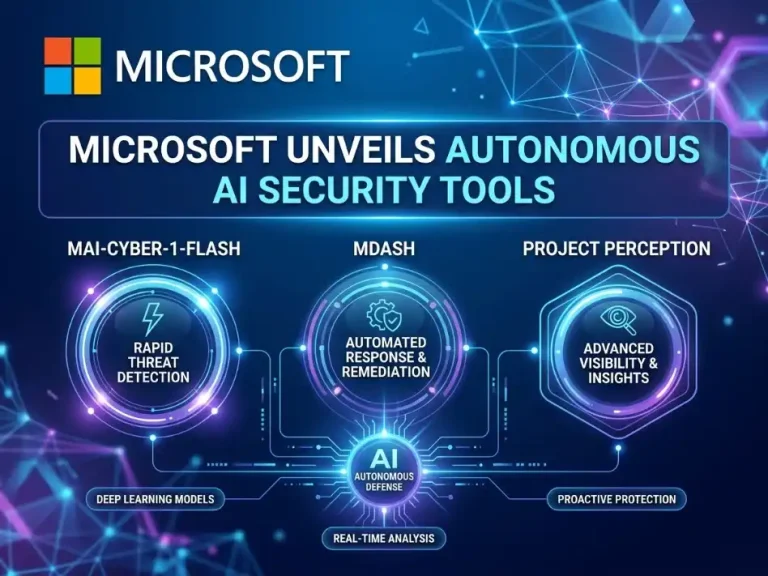
On July 27, 2026, Microsoft released its first domain-specific generative AI model for cybersecurity, MAI-Cyber-1-Flash, running inside the MDASH multi-agent platform. The same announcement introduced Project Perception, an autonomous defensive framework built around specialized Red, Blue, and Green AI agents.
Enterprise security teams face rising volumes of vulnerabilities, false positives from traditional scanners, and pressure to patch faster. Microsoft’s approach pairs a lean, security-tuned model with multi-agent orchestration to reduce both time-to-remediation and compute cost.
Overview of the Announcement
Microsoft’s stack combines a specialized model with an orchestration harness and a continuous multi-agent workflow. The goal is continuous vulnerability detection, risk prioritization, and code remediation with less human overhead and lower operational cost than general-purpose frontier models.
An agentic cybersecurity system uses autonomous software agents powered by domain-trained language models to perform multi-step threat hunting, prioritization, and automated patching under defined controls.
Architecture: MAI-Cyber-1-Flash and MDASH
MAI-Cyber-1-Flash is Microsoft’s security-focused model optimized for vulnerability detection, patch generation, and low-latency code analysis. MDASH (Multi-Agent Vulnerability Identification and Remediation Harness) is the orchestration layer that manages state, memory, context graphs, and routing of tasks across models.
Core components:
- MAI-Cyber-1-Flash – handles vulnerability identification and patch synthesis at lower compute cost.
- MDASH Harness – provides state management, context querying, and dynamic model multiplexing.
- Microsoft Security Graph integration – supplies real-time telemetry and environment topology for higher contextual accuracy.
| System Component | Primary Function | Key Operational Advantage |
|---|---|---|
| MAI-Cyber-1-Flash | Vulnerability identification & patch generation | High accuracy at roughly 50% lower compute cost |
| MDASH Harness | Multi-agent orchestration & model routing | Assigns tasks to the most suitable model |
| Project Perception | End-to-end continuous security governance | Closed-loop discovery, analysis, and remediation |
Simple or routine security tasks route to MAI-Cyber-1-Flash. Complex reasoning steps can still call larger frontier models when needed. This multiplexing keeps average costs down.
Project Perception: Red, Blue, and Green Agents
Project Perception turns the classic red-team / blue-team dynamic into an automated three-agent loop controlled by MDASH.
Red Agents continuously examine source code, configurations, and API surfaces to surface potential attack paths, including logic flaws and memory-safety issues.
Blue Agents take the findings and evaluate real exposure inside the enterprise environment graph. They filter false positives and score severity by exploitability, asset value, and business impact.
Green Agents generate candidate patches and configuration fixes, validate them in staging sandboxes, and prepare approved updates for deployment.
The agents operate in a continuous cycle rather than one-off scans.
CyberGym Benchmark Results and Cost Comparison
On the CyberGym benchmark- which tests autonomous reproduction and remediation of 1,507 verified vulnerabilities across 188 open-source projects—the MAI-Cyber-1-Flash + MDASH combination recorded a 95.95% success rate. That result sat ahead of several competing frontier-model approaches while using approximately half the relative compute cost.
| Model / Platform Combination | CyberGym Score | Relative Compute Cost |
|---|---|---|
| MAI-Cyber-1-Flash + MDASH (Microsoft) | 95.95% | Baseline (50% cost savings) |
| Anthropic Mythos 5 | 83.95% | 2.0× baseline |
| OpenAI GPT-5.6 Sol / GPT-5.5 Cyber | 88.10% | 2.0× baseline |
| Google 3.5 Flash Cyber | 85.40% | 1.8× baseline |
Routing routine work to the specialized model and reserving larger models for harder reasoning steps accounts for most of the cost reduction.
Industry Context and Safety Considerations
The release arrives amid growing attention to the risks of unconstrained autonomous agents. Agents that can execute code, call APIs, or change system state introduce new attack surfaces if permissions are too broad.
Microsoft’s MDASH design emphasizes deterministic boundaries, immutable logging, and isolated execution containers. Without least-privilege rules, sandboxed environments, and explicit authorization points, automated agents can create operational risk.
Best Practices for Deploying Agentic AI Security
Teams evaluating or deploying similar systems should apply these controls:
- Require human-in-the-loop approval before any automated patch or configuration change reaches production.
- Limit each agent to the minimum repository context and temporary credentials needed for its task.
- Run offensive and remediation agents inside ephemeral, isolated sandboxes.
- Capture every decision, generated patch, and system interaction in an immutable audit log.
- Use hybrid orchestration so specialized security models handle routine work and larger models handle complex cases only when necessary.
Frequently Asked Questions
What is Microsoft MAI-Cyber-1-Flash?
MAI-Cyber-1-Flash is Microsoft’s first domain-specific generative AI model built for cybersecurity tasks. It focuses on rapid vulnerability identification, threat analysis, and automated code-patch synthesis inside the MDASH harness.
What is Project Perception?
Project Perception is Microsoft’s agentic security framework that coordinates specialized Red (discovery), Blue (risk analysis), and Green (remediation) AI agents to monitor and secure software environments on a continuous basis.
How does MAI-Cyber-1-Flash reduce operational costs by about 50%?
The model is optimized for security workloads. The MDASH harness routes routine scans and patch generation to it, calling more expensive general-purpose models only when complex reasoning is required.
What is the CyberGym benchmark?
CyberGym evaluates AI systems on their ability to reproduce, analyze, and repair 1,507 real-world vulnerabilities drawn from 188 open-source projects.
When will Project Perception and MAI-Cyber-1-Flash be available?
Public preview of Project Perception and MAI-Cyber-1-Flash inside MDASH is scheduled to begin August 3, 2026.
Conclusion
Microsoft’s combination of a domain-tuned model, a multi-agent harness, and the Project Perception workflow offers a practical path toward faster, lower-cost vulnerability management. The performance numbers on CyberGym are strong, yet the real long-term value will depend on how carefully organizations apply least-privilege controls, isolation, logging, and human oversight. Agentic security tools can reduce backlog and accelerate remediation only when the surrounding governance keeps the agents inside safe boundaries.
Visit Our Recommended Websites
Here are our trusted partners and resources for your requirements: